

What Is the CRICOS Freeze?
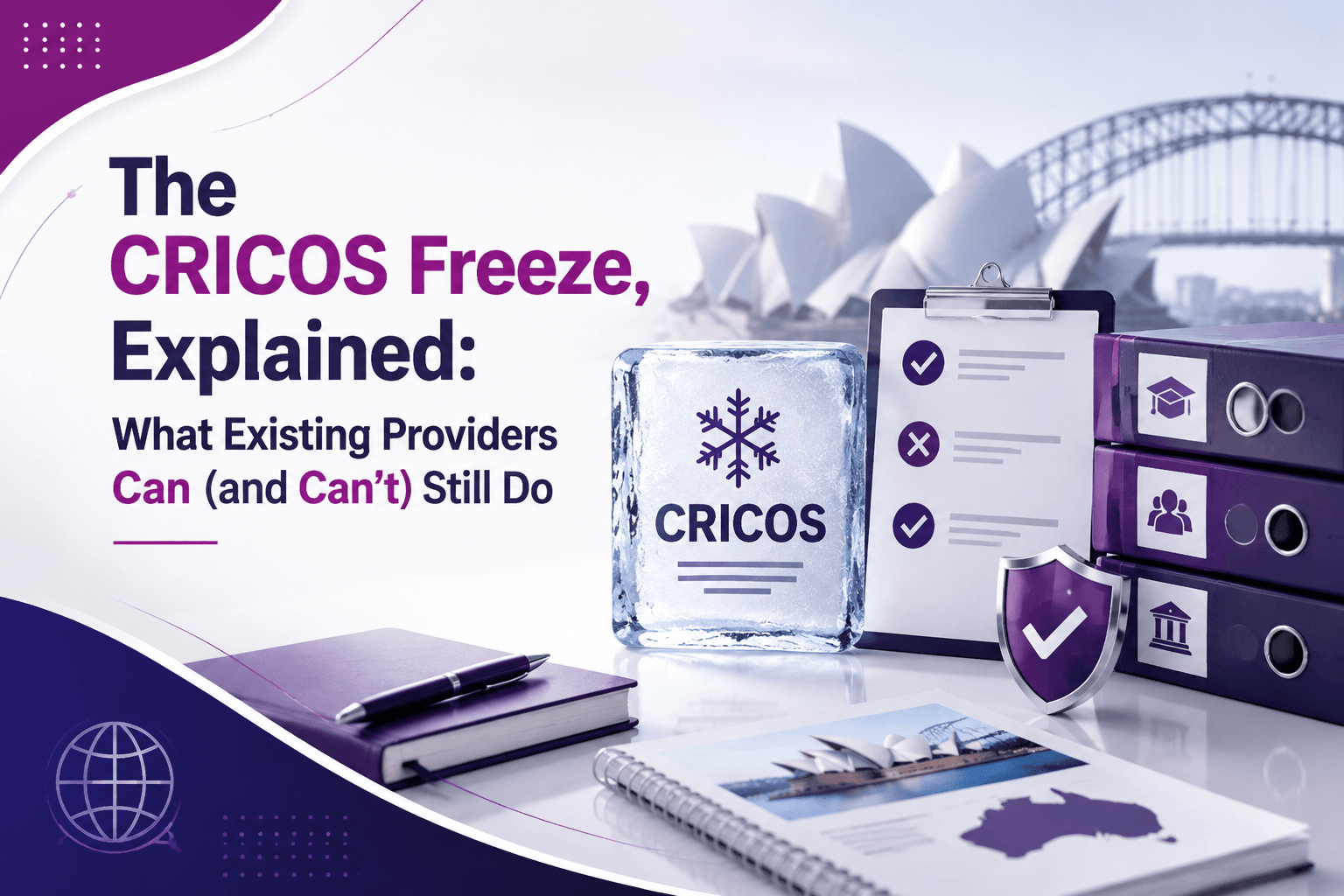
This freeze is a 12-month suspension on new applications to the Commonwealth Register of Institutions and Courses for Overseas Students (CRICOS), running from 19 May 2026 to 19 May 2027. During this period, the Australian Skills Quality Authority (ASQA) won’t accept applications from new private VET or English Language Intensive Courses for Overseas Students (ELICOS) providers, nor will it register new courses for existing private providers looking to expand their scope for international students.
The freeze operates under powers enabled by the Education Legislation Amendment (Integrity and Other Measures) Act 2025, which gives ASQA the legal authority to pause new applications sector-wide rather than assessing them case by case. There’s a flow-on effect for prospective students too: student visa (subclass 500) applicants generally need to show they’ve enrolled with a provider that already holds CRICOS registration, or risk having their visa application refused at lodgement.

Why Was the Freeze Introduced?

The federal government introduced the freeze to address integrity concerns that had been building across the international education sector. Government reviews identified a pattern of non-genuine enrolments, rapid course-hopping between providers, and student visas being used as a pathway to work rather than study. Consequently, regulators wanted breathing room to tighten oversight before allowing new entrants back into the market.
The scale of the problem helps explain the response. In some South Asian markets, offshore student visa refusal rates topped 69 per cent in early 2026, and ELICOS commencements fell by roughly a third through 2025 as confidence in parts of the sector wavered. With international education worth an estimated $44 billion a year to the Australian economy, protecting the sector’s reputation was judged to outweigh the short-term inconvenience to prospective new providers.
For established, compliant RTOs, this is largely welcome news. Fewer new entrants means less competition for genuine student demand, and it signals that ASQA increasingly expects providers to demonstrate real, evidenced quality rather than paper compliance.
What This Means for the Wider Market
The freeze isn’t just a compliance footnote; it’s reshaping the competitive landscape. With roughly 1,100 private CRICOS-registered colleges already operating and no new entrants permitted until May 2027, existing providers are absorbing demand that would otherwise have gone to new competitors. Agents report that popular metropolitan colleges are already nearing capacity for upcoming intakes, pushing prospective students toward providers with genuine spare capacity and a track record of compliance.

What Existing CRICOS Providers Can Still Do
If your RTO already holds CRICOS registration, the freeze changes less than you might expect.

Continue Delivering Your Current Courses

What Existing Providers Can’t Do
How Should RTOs Prepare While the Freeze Is in Place?
- Review your governance framework against the 2025 Standards for RTOs, including fit and proper person requirements and trainer currency records.
- Audit your agent agreements to ensure they comply with the ban on commissions for onshore transfers.
- Pressure-test your assessment and validation systems so evidence holds up under closer ASQA scrutiny.
- Document everything, since ASQA’s shift toward risk-based, decisive regulatory action rewards providers who can produce clear evidence on demand.
- Plan your scope strategy now, so you’re first in line, not scrambling, when applications reopen in May 2027.
Ultimately, providers with clean, well-documented systems will be best placed to expand quickly once the freeze lifts, while those still catching up will be left behind. If you’re unsure exactly where your RTO stands, a compliance review now is far cheaper than a scramble later.

Frequently Asked Questions
Does the CRICOS freeze apply to TAFEs and universities?
When does the CRICOS freeze end?
Can I still apply if I lodged my application before the freeze started?
Does the freeze put my existing CRICOS registration at risk?
What's the legal basis for the CRICOS freeze?
Could the freeze be extended past May 2027?
The CRICOS freeze isn’t a shutdown; it’s a pause on new entrants while regulators focus on sector integrity. For existing providers, the message is clear: keep delivering, keep your compliance sharp, and use the next twelve months to prepare for growth once the freeze lifts. In the meantime, reduced competition gives compliant providers a genuine opportunity to strengthen their position in the market. For the official government notice, see the Study Australia website.
If you’d like help getting audit-ready before the freeze lifts, VET Advisory Group’s compliance team is here to help.
- Home
- .
- The CRICOS Freeze, Explained: What Existing Providers Can (and Can’t) Still Do
- .