
Registered Training Organisations (RTOs) in Australia operate in one of the most tightly regulated education sectors, governed by national standards enforced by the Australian Skills Quality Authority (ASQA). As 2025 approaches, RTOs are expected not only to maintain high-quality training delivery but also to demonstrate compliance through robust documentation, evidence, and governance frameworks.
This blog outlines the top RTO compliance challenges expected in 2025 and provides practical, actionable strategies for training organisations to stay audit-ready and compliant.
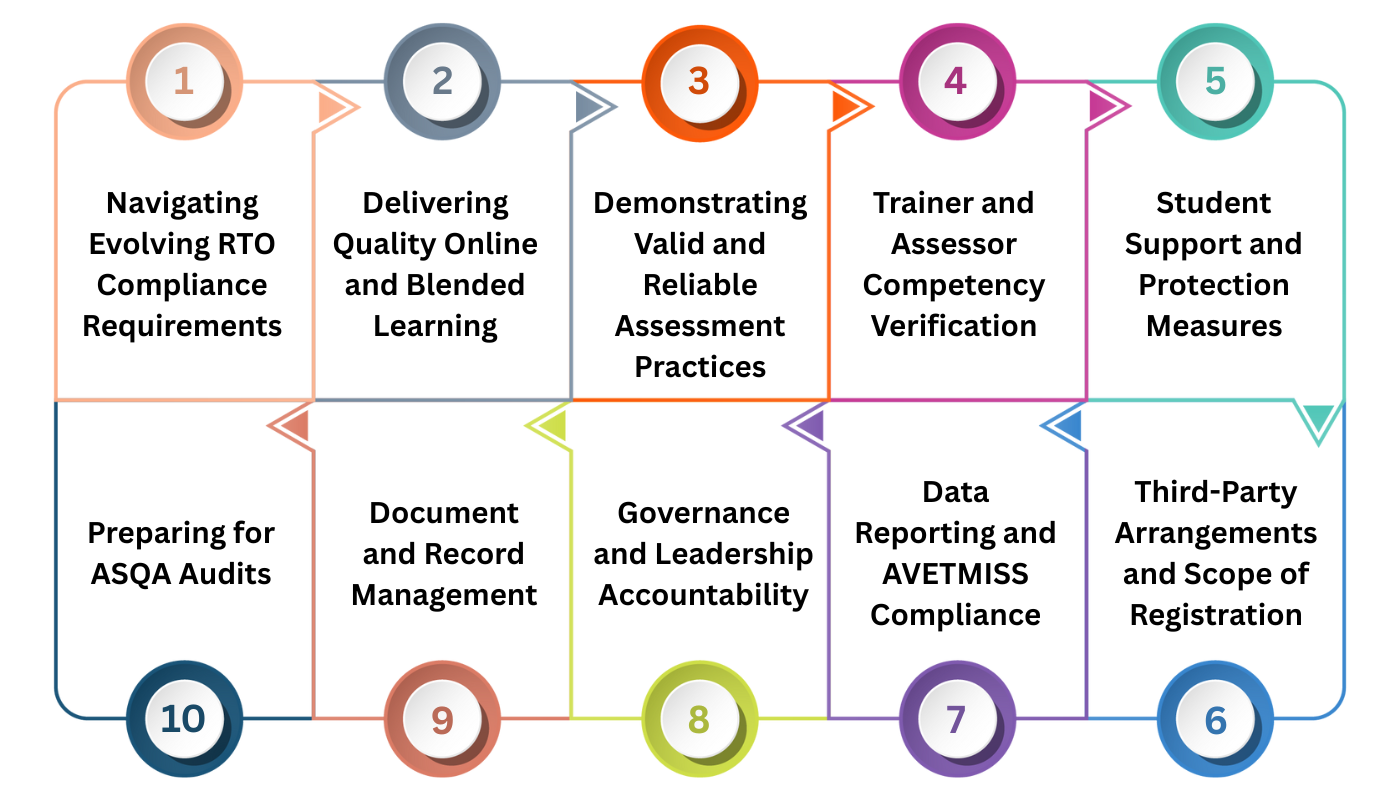
1. Navigating Evolving RTO Compliance Requirements
One of the biggest challenges RTOs face in 2025 is keeping pace with changing RTO compliance requirements. Regulatory updates from ASQA and revisions to the Standards for RTOs mean that providers must stay vigilant.
Key 2025 updates may include:
- Revisions to the Standards for RTOs 2015, especially relating to online delivery and workforce readiness.
- Enhanced reporting obligations via AVETMISS and Quality Indicator Surveys.
- Greater scrutiny on assessment integrity and learner support systems.
How RTOs Can Overcome This:
- Subscribe to ASQA newsletters and attend compliance webinars.
- Conduct quarterly internal audits to evaluate and monitor compliance gaps.
- Appoint a dedicated RTO compliance officer or external consultant to oversee changes.
2. Delivering Quality Online and Blended Learning
Post-pandemic, many RTOs shifted to online or hybrid learning models. However, many still struggle to align their delivery with RTO compliance standards, especially in terms of assessment validation and learner engagement.
Common Issues:
- Verifying student identity during online assessments.
- Maintaining learner engagement in virtual classrooms.
- Upholding trainer-to-student ratios.
How RTOs Can Overcome This:
- Use a Learning Management System (LMS) that provides engagement analytics and audit trails.
- Regularly moderate online assessments to ensure validity.
- Develop a formal online delivery policy in line with ASQA’s guidelines.
3. Demonstrating Valid and Reliable Assessment Practices
Assessment compliance is a key area where RTOs are frequently non-compliant. ASQA continues to report that many assessments lack validity, reliability, sufficiency, or alignment with the training package.
In 2025, RTOs will need to focus on:
- Industry consultation in assessment design.
- Continuous improvement based on student outcomes.
- Comprehensive mapping to unit of competency requirements.
How RTOs Can Overcome This:
- Involve industry stakeholders in validation sessions.
- Use assessment mapping tools to ensure alignment.
- Conduct annual staff training on assessment development.
4. Trainer and Assessor Competency Verification
Maintaining current qualifications and vocational competencies for trainers and assessors is a non-negotiable compliance requirement under Clauses 1.13–1.16 of the Standards.
Key 2025 Focus Areas:
- Evidence of vocational currency.
- Documented professional development (PD)
- Active industry engagement
How RTOs Can Overcome This:
- Maintain a PD register and update it regularly.
- Require trainers to undertake annual industry currency activities.
- Store qualifications and PD records in a central cloud system for easy access during audits.
5. Student Support and Protection Measures
Student welfare and access to equitable learning are growing priorities in RTO compliance. RTOs must demonstrate that they provide adequate support and have processes in place to resolve grievances.
Compliance Issues to Watch in 2025:
- Transparent fee disclosures.
- Accessibility for learners with disabilities.
- Timely handling of complaints and appeals.
How RTOs Can Overcome This:
- Publish all information in plain English across digital and print formats.
- Appoint a Student Support Officer.
- Conduct annual reviews of your complaints and appeals policy.
6. Third-Party Arrangements and Scope of Registration
RTOs that partner with third-party providers often underestimate the level of compliance risk these relationships carry.
ASQA requires you to:
- Maintain a written agreement.
- Disclose the third-party arrangement to students.
- Monitor delivery quality consistently.
How RTOs Can Overcome This:
- Create a third-party monitoring framework.
- Perform quarterly site audits for all partner locations.
- Report and update arrangements with ASQA as required.
7. Data Reporting and AVETMISS Compliance
AVETMISS and USI reporting are fundamental to your RTO’s compliance footprint. Inaccuracies can trigger audits and lead to regulatory action.
Common Data Challenges:
- Mismatched student outcomes.
- Incorrect USI entries.
- Delayed or invalid submissions.
How RTOs Can Overcome This:
- Use RTO software that seamlessly integrates with NCVER and USI systems.
- Assign trained staff for data validation and reporting.
- Conduct regular data integrity audits.
8. Governance and Leadership Accountability
ASQA is increasingly holding RTO leadership accountable for operational compliance. In 2025, the focus is shifting towards outcomes, quality systems, and financial sustainability.
Expect more scrutiny on:
- Risk management protocols.
- Governance structure.
- Continuous improvement initiatives.
How RTOs Can Overcome This:
- Develop and implement a Compliance Governance Framework.
- Include compliance metrics in your board or management meetings.
- Engage third-party auditors for annual assessments.
9. Document and Record Management
Recordkeeping is not only a compliance requirement but also essential for operational efficiency. In 2025, digital documentation will become standard.
Key Compliance Areas:
- Trainer qualifications and PD logs.
- Student enrolments and assessment evidence.
- Communication and complaints logs.
How RTOs Can Overcome This:
- Implement a secure cloud-based document management system.
- Standardise naming conventions and folder structures.
- Train staff on document version control and audit preparation.
10. Preparing for ASQA Audits
Many RTOs find ASQA audits daunting due to their unpredictable nature and depth of scrutiny. Audits in 2025 may be risk-based and outcome-focused, especially for high-risk providers.
How RTOs Can Overcome This:
- Conduct mock audits every 6 months.
- Maintain a living compliance calendar.
Assign team members to specific audit checklist items with deadlines.
Conclusion: Make Compliance a Core Strategy in 2025
RTO compliance in 2025 will not just be about avoiding penalties—it will be about building a culture of continuous improvement. By understanding the evolving compliance landscape and proactively embedding best practices into operations, your RTO can thrive.
Key Takeaways for RTOs:
- Stay informed with ASQA updates and future standards.
- Invest in systems, staff training, and internal audits.
- Make compliance a daily operational mindset, not just a checklist.
Need support in developing your RTO’s compliance strategy?
Consider engaging a professional VET compliance consultant to help you assess readiness and implement best-practice frameworks for RTO compliance in 2025 and beyond.