Introduction
Understanding ASQA Trainer and Assessor Requirements
Meeting ASQA trainer and assessor requirements is essential for maintaining the quality of training and assessment across Australia. These rules are outlined in Clauses 1.13 – 1.16, and they ensure that trainers and assessors have the necessary skills, knowledge, and qualifications to deliver vocational education.
To meet ASQA Standards, your RTO must ensure that trainers and assessors:
- Hold vocational competencies at least equal to the level they are delivering.
- Possess current industry skills relevant to the training product.
- Have appropriate training and assessment qualifications, such as Certificate IV in Training and Assessment (e.g., TAE40116 or its successor)
By following these guidelines, RTOs can demonstrate they are delivering quality education that aligns with national standards.
Core competencies for trainers and assessors
The core competencies required for trainers and assessors ASQA guidelines, are essential to maintain the credibility of your RTO and the Quality of RTO resources we deliver.
Trainers must have the vocational competencies for the training they provide. This means that trainers must either hold the exact qualification they are teaching or demonstrate equivalence through mapping skills to unit requirements.
Additionally, trainers and assessors must maintain current industry skills through activities like:
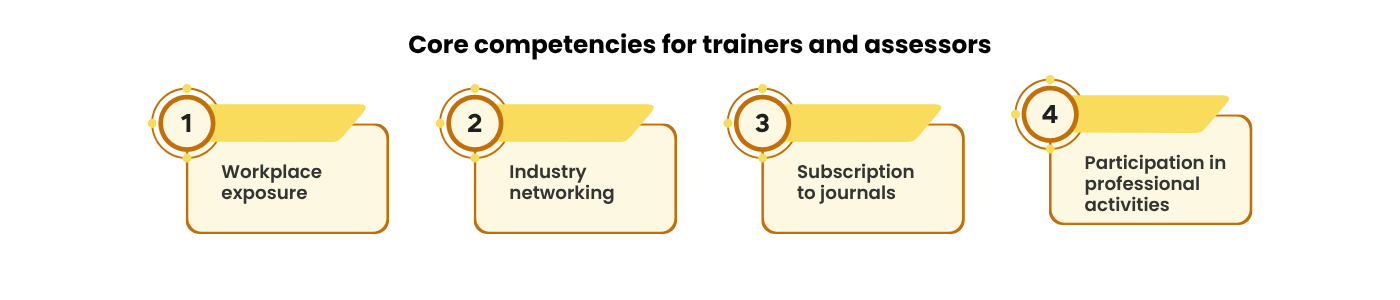
- Workplace exposure
- Industry networking
- Subscription to journals
- Participation in professional activities
How to Maintain Industry Currency for Trainers and Assessors
To meet ASQA trainer and assessor requirements, trainers and assessors need to maintain current industry skills and knowledge. ASQA requires that trainers and assessors are familiar with the latest industry trends and practices to ensure that training is relevant and up to date.
Here’s how to maintain industry currency:
- Engage in industry-specific activities
- Participate in workplace exposure
- Collaboration with industry partners
- Stay up to date on the latest training methods.
Compliance Strategies for RTO
To ensure your RTO meets ASQA training and assessor requirements, effective verification and documentation systems are necessary. Proper documentation not only demonstrates compliance during audits but also ensures transparency and consistency across your organisation.
Key compliance actions include:
Verifying Qualifications
Ensure the trainer holds the required TAE qualifications and maintains a clear record of them.Recording Industry Exposure
Ensure that the trainer has prior industry experience to prove their skills and maintain it as evidence.Tracking Professional Development
Trainers must document workshops, training sessions, and conferences attended and maintain records of their professional development activities. Regular audits should be conducted to ensure all documents are up to date and align with ASQA requirements. This includes establishing a clear credential verification system and ensuring trainers consistently follow their rules in line with industry standards.Supervising Unqualified Staff: How to Stay Compliant
In some cases, industry experts without formal qualifications may be employed to assist with training delivery.
However, to meet ASQA trainer and assessor requirements, they must be supervised by qualified trainers. These experts assist with training delivery but cannot make assessment judgments or independently assess students.
RTOs must ensure a clear system for appropriate supervision to maintain quality assurance and remain compliant with ASQA regulations.
Preparing for the 2025 ASQA Standards Changes
The ASQA 2025 Standards focus on structured workplace planning, development, and assessment. RTOs must adapt to the following changes:
- Trainers and assessors must meet the revised qualification requirements, including the latest TAE certifications and relevant industry qualifications, ensuring their credentials align with ASQA’s updated standards.
- RTOs should establish new strategies for ongoing professional development, including participation in industry events, workshops, and training updates to maintain currency in their field.
- Ongoing collaboration with industry stakeholders is essential for keeping training content relevant and ensuring that trainers remain up-to-date with the latest industry trends and standards. By proactively addressing these areas, RTOs can maintain compliance, enhance the quality of training, and mitigate the risks of non-compliance in future audits.
FAQs
1. What are the key ASQA requirements for trainers and assessors in RTOs?
ASQA requires trainers and assessors to hold relevant credentials, such as TAE40116 Certificate IV in Training and Assessment, and maintain current industry skills.
2. How do I verify that my trainers meet ASQA’s requirements?
You need to make sure trainees have the right qualifications, like TAE40116, have relevant industry experience, and participate in ongoing professional development.
3. What happens if my RTO’s trainers don’t meet ASQA requirements?
The RTO could face penalties, fail audits, or lose its registration if its trainer does not meet ASQA requirements.
4. Can a trainer without a TAE40116 Certificate still be eligible to assess?
Sure, but only under a trainer and assessor’s supervision. Without the TAE40116 Certification, they can’t make independent assessment judgments.
5. How often should RTO trainers engage in professional development?
Every year, trainers should keep up with industry practices, training g methods, and the latest developments.
6. What qualifications are required to become a trainer and assessor under ASQA?
The minimum qualification for a trainer and assessor is TAE400116. For delivering higher-level training, you need higher qualifications such as the Diploma of Vocational Education and Training (TAE50116) or the Diploma of Training Design and Development(TAE50216).
7. How do trainers maintain industry currency to meet ASQA requirements?
In order to maintain industry currency, trainers need exposure to workplaces, industry networking, and involvement in industry-related events.
8. What should RTOs do to prepare for ASQA audits?
To demonstrate compliance during audits, RTOs need to keep accurate records of trainer qualifications and documentation.
9. Can an RTO use unqualified industry experts for training purposes?
Yes, but unqualified experts need to be supervised. They can’t assess students or make judgments about them on their own. An RTO must ensure proper supervision and maintain training and assessment integrity.
10. How can RTOs prepare for the ASQA 2025 Standards changes?
Trainers need to update their skills to meet revised TAE standards, implement strategies for ongoing professional development, and work with industry stakeholders to keep their content relevant.
Conclusion
ASQA trainer and assessor meeting ASQA trainer and assessor requirements is an ongoing process for RTOs. It’s done by verifying qualifications, maintaining trainers’ currency, and their engagement with the industry partner. By doing these, you can ensure your RTO remains compliant and delivers high-quality training that meets the national standards.
About the author

Ben Thakkar
15+ yrs experienceCompliance, Training & Business Specialist · VET Advisory Group
Ben Thakkar is a Compliance, Training, and Business specialist in the education industry. He has held senior management roles, including General Manager, with leading Registered Training Organisations (RTOs) and Universities. With over 15 years of experience, Ben brings extensive expertise across audits, funding contracts, VET Student Loans, CRICOS, and the Standards for RTOs 2025.