

Assessments are very important for training providers and students. But how do training providers like RTOs be sure their assessments complement the learning outcomes? It is possible through assessment mapping. From our experience in the VET sector, it is evident to us that assessment mapping highlights if the training package requirements are met and it also boosts the delivery and assessment of training products.
This blog will help you learn and understand:
- What is assessment mapping?
- Why RTOs need assessment mapping?
- How to do assessment mapping?
- Assessment mapping template
- How to use assessment mapping in an online assessment
What is Assessment Mapping?
Assessment Mapping is the process of mapping assessment tasks and activities with the learning outcomes of a unit of competency. Assessment mapping ensures that the assessment is fully capable of collecting evidence across the entire unit.
Assessments are mapped against
- Elements and performance criteria
- Performance and knowledge evidence requirements
- Foundation Skills
Does ASQA mandate assessment mapping?
While the Australian Skills Quality Authority (ASQA) does not explicitly mandate assessment mapping for registered training organisations (RTOs), the requirement to “demonstrate the validity of their assessment tools” necessitates its crucial role in the process.
Why RTOs need assessment mapping?
For RTOs assessment mapping unlocks valuable insights into student performance and program effectiveness, ensuring compliance while continuously optimising the learning journey. Let’s look at the reasons why RTOs need assessment reasons:
- Assessment mapping helps guarantee that your assessments accurately measure the learning outcomes outlined in your units and qualifications. This means you’re assessing what you’re supposed to be assessing, leading to more valid and reliable results.
- Auditors love assessment mapping! It provides a clear and organised way to show them how your assessments align with unit requirements and regulatory standards. This saves you time and stress during audits, as you can easily demonstrate compliance.
- By mapping assessments to learning outcomes, you can quickly pinpoint areas where learners are struggling. This allows you to provide targeted feedback and support to help them improve.
- Assessment Mapping helps you identify any unnecessary redundancy or gaps in your assessments. This means you can streamline your assessment process, saving time and resources for both you and your learners.
- Effective assessment mapping leads to more accurate and reliable assessments, which in turn leads to better learning outcomes for your students. This can ultimately improve the quality of your entire RTO program.
- Assessment mapping helps you to develop more effective assessments with targeted focus, variety and balance and reduced redundancy.
- Assessment mapping improves clarifies roles and responsibilities for assessment development, revision, and feedback, promoting accountability and shared ownership of program quality.
- Assessment mapping data helps identify trends and patterns in student performance, enabling data-driven decision-making about curriculum adjustments, resource allocation, and teaching strategies.
Here is a table summarising the benefits of assessment mapping
| Benefit | Explanation |
| Valid and Reliable Assessments | Ensures assessments accurately measure learning outcomes, leading to trustworthy results. |
| Simplified Compliance Demonstrations | Provides clear evidence for auditors, showing alignment with unit requirements and regulations. |
| Identifying Learner Knowledge Gaps | Pinpoints areas of struggle, allowing for targeted feedback and support to improve learning. |
| Streamlined Assessment Process | Identifies redundant or missing assessments, optimising time and resources. |
| Improved Program Quality | Leads to more accurate assessments, ultimately enhancing student learning and program effectiveness. |
| Developing Effective Assessments | Promotes targeted focus, variety, and balance, reducing redundancy and creating relevant tasks. |
| Improved Communication and Collaboration | Clarifies roles and responsibilities for assessment development, fostering accountability and program ownership. |
| Data-Driven Decision Making | Provides insights into student performance, enabling data-driven adjustments to curriculum, resources, and teaching strategies. |
Assessment Mapping Template
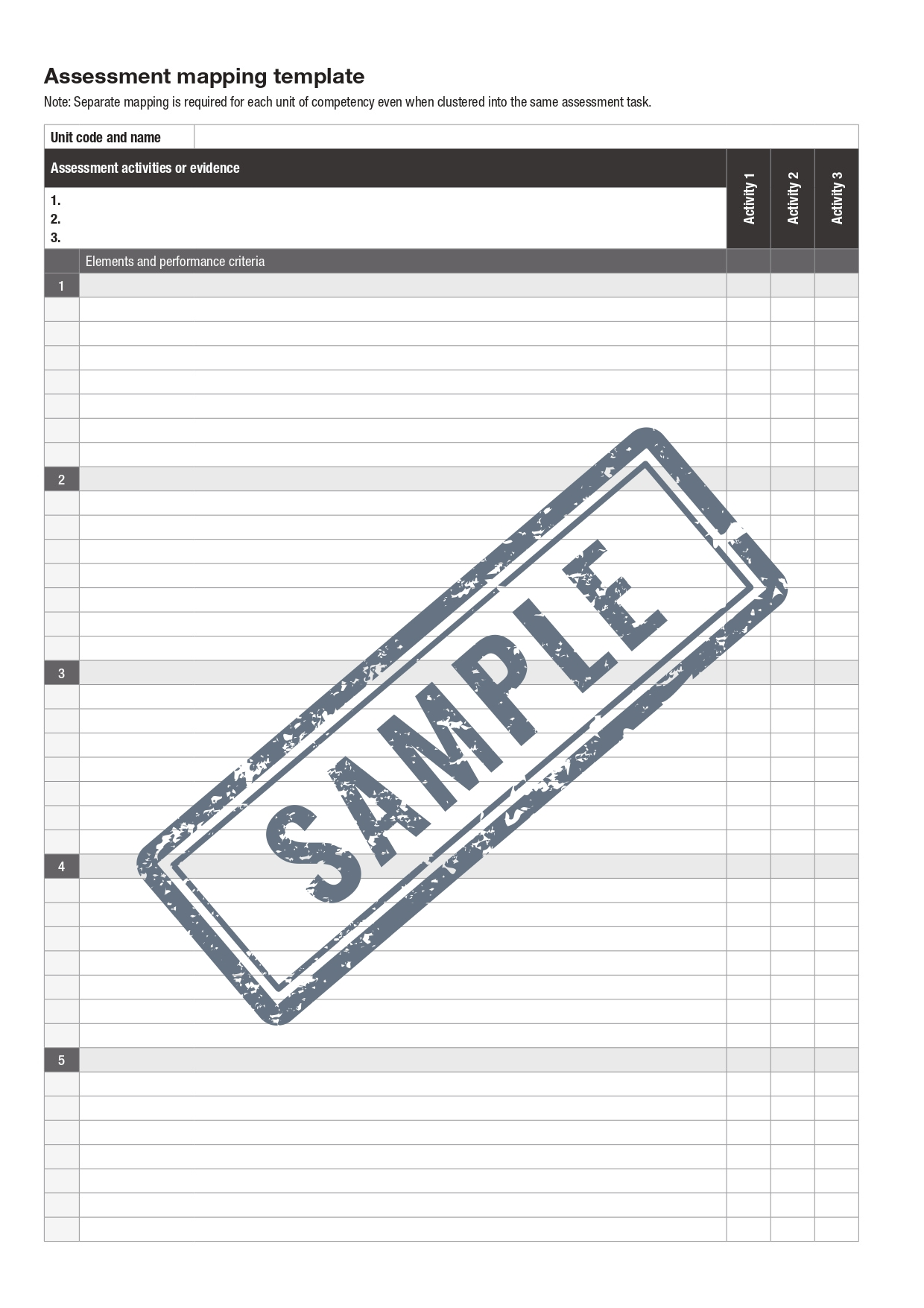
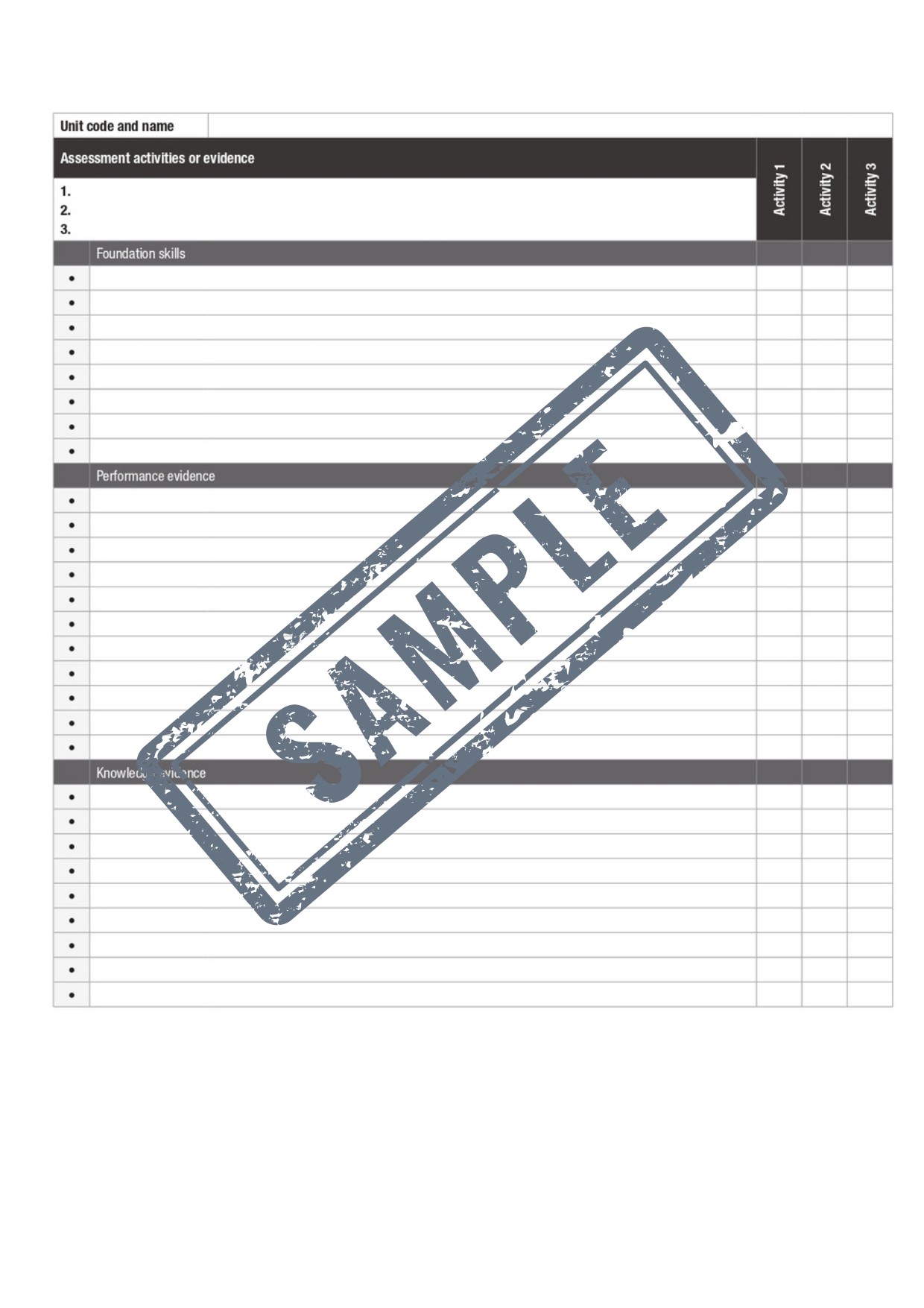
This is how a standard assessment mapping document looks. You will be entering activities against performance evidence, criteria and so on.
How to do Assessment Mapping?
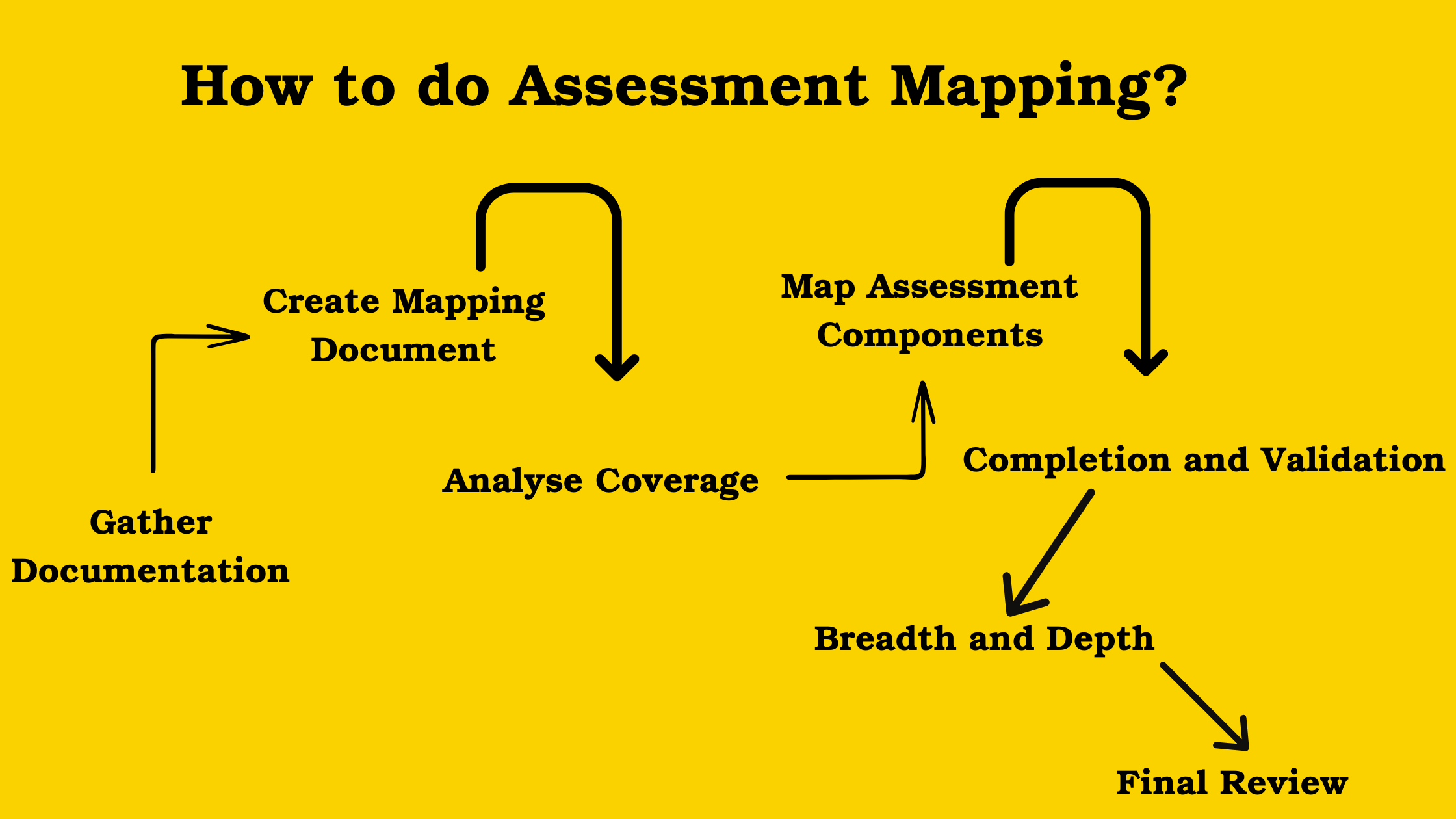
In our experience of creating mapping documents, we have cracked the way to do accurate assessment mapping and here it is:
- Gather Documentation: Organise your assessment plan, instruments, marking guides, reports, and samples electronically or in a dedicated workspace.
- Create Mapping Document: Generate a document with copied units of competency, including knowledge, performance, and foundation skills sections. Create a table with columns for each performance criterion and evidence statement. (Refer to the Assessment Mapping Template of this blog)
- Analyse Coverage: Review each criterion, evidence statement, and skill to determine if your assessments adequately address them. Consider whether questions and activities will generate sufficient evidence.
- Map Assessment Components: For covered criteria, record the corresponding task/question number or reference in the designated table column.
- Completion and Validation: Ensure all unit components are mapped. Any unmapped criteria require validation for future development.
- Breadth and Depth: Aim for at least one, preferably more, assessment item per criterion. Ensure practical skills, knowledge, and performance examples are adequately assessed.
- Final Review: Verify your mapping against assessment guidelines to confirm sufficient evidence capture. Ensure multiple performance examples are assessed for relevant criteria.
How to do Assessment Mapping in an Online Assessment?
To do assessment mapping for an online assessment you can follow these steps:
Step 1 Define Learning Outcomes
- Clearly articulate the specific knowledge, skills, and abilities students should demonstrate upon completion of the online course or module.
- Use concise, measurable language to frame the learning outcomes, ensuring alignment with overall course or program objectives.
Step 2 Choose Appropriate Assessment Types
- Consider the suitability of different assessment formats for online delivery, such as:
- Multiple-choice quizzes
- Short answer questions
- Essays
- Projects
- Simulations
- Case studies
- Portfolios
- Peer assessments
- Select assessment types that effectively measure the intended learning outcomes while considering technical constraints and student accessibility.
Step 3 Create a Visual Map
- Use a table, grid, or software tool to create a visual representation of the assessment mapping.
- List learning outcomes along one axis and assessment tasks along the other.
- Indicate which tasks align with which outcomes, ensuring comprehensive coverage and avoiding redundancy.
Step 4 Integrate with Online Assessment Platform
- If using a dedicated online assessment platform, input assessment tasks and link them to the corresponding learning outcomes within the system.
- This facilitates automated tracking of student progress and alignment with course objectives.
- If using a simpler approach, create a clear document or online resource that outlines the assessment mapping for students and instructors.
Step 5 Pilot Test and Gather Feedback
- Conduct a trial run of the online assessments with a small group of students.
- Gather feedback on the clarity of instructions, technical functionality, and the overall assessment experience.
- Use this feedback to refine the assessments and mapping as needed.
Step 6 Continuously Review and Improve
Regularly review assessment results and mapping data to identify areas for improvement.
The following table summarises the steps for you.
| Steps | Description |
| Define Learning Outcomes | Clearly articulate specific knowledge, skills, and abilities students should demonstrate. |
| Choose Appropriate Assessment Types | Consider suitability of different assessment formats for online delivery (e.g., quizzes, essays, simulations). |
| Create a Visual Map | Use a table, grid, or software to map assessment tasks to learning outcomes. |
| Integrate with Online Assessment Platform | Input tasks and link them to outcomes within the system (if using one). |
| Pilot Test and Gather Feedback | Conduct a trial run with a small group of students and gather feedback. |
| Continuously Review and Improve | Regularly review assessment results and mapping data to identify areas for improvement. |
Also Consider:
- Are all learning outcomes being adequately assessed?
- Are there any gaps or redundancies in the assessment tasks?
- Are students performing as expected?
- Can any assessments be modified to better measure student learning?
- Make adjustments based on data and feedback to ensure the ongoing effectiveness of your assessment mapping strategy.
Conclusion
Assessment mapping is important for RTOs and their trainers as it accurately highlights the effectiveness of assessments. In this blog, we’ve demystified the essential practice of assessment mapping for RTOs. We’ve explored its pivotal role in ensuring your assessments precisely measure student achievement against targeted learning outcomes. By employing mapping techniques, you unlock a cascade of benefits:
- Confident Compliance: Mapping showcases clear alignment with training package requirements and regulatory standards, easing audit anxieties and highlighting your commitment to quality.
- Boosted Learning Delivery: Identifying gaps and redundancies through mapping allows for optimised training delivery, focusing resources on areas that truly matter for student success.
- Enhanced Assessment Practices: Mapping guides the development of targeted, relevant assessments that accurately capture evidence of student competency, maximising assessment effectiveness and student confidence.
- Continuous Improvement: Mapping facilitates data-driven analysis of student performance, enabling you to pinpoint areas for improvement and refine your program for ongoing excellence.
Remember, assessment mapping is not a one-and-done process. Embrace it as a dynamic tool for continual evaluation and enhancement of your training and assessment practices. By investing in this crucial step, you empower yourself to deliver exceptional learning experiences and confidently demonstrate the true value of your RTO.
Looking for help and guidance on how to do assessment mapping for your RTO assessments?
VET Advisory Group is the right option for you. We have expertise in RTO management, RTO operations, developing courses and contextualising training material. To get a free sample or book a free consultation contact us here.
Frequently Asked Questions
Who uses assessment mapping in VET sector?
Course developers, RTO administrators, trainers, assessors and auditors use assessment mapping as an industry-standard practice.
How can I use technology to support assessment mapping?
Dedicated Mapping Software, learning Management Systems (LMS), cloud-based collaboration tools and data automation are some ways you can support assessment mapping with technology.
What are the challenges of using online assessments in assessment mapping?
Maintaining standardisation and fairness in assessment, security and integrity of assessment mapping, accessibility of online assessments and reliability in the assessment mapping are few challenges of online assessments in mapping.
How can I involve stakeholders in the assessment mapping process?
Ways you can engage stakeholders in assessment mapping are involving subject matter experts, gather student feedback, engaging administrative staff and create open communication channels.