


Introduction
The blog “What Role Does Industry Currency Play in Quality Training? ASQA Standards Explored” delves into the significance of industry currency in vocational education and Registered Training Organisations (RTOs). Let us begin.
What is Industry Currency?
Industry currency refers to the maintenance of a trainer’s vocational technical skills and knowledge in a particular industry. It enables trainers and assessors to deliver vocational training that aligns with current industry practices and standards. Being industry current ensures that trainers stay up to date with the latest developments and trends in their field, allowing them to provide relevant and effective training to students.
Who are the stakeholders of industry currency?

What are ASQA Standards for industry currency or ASQA trainer requirements?
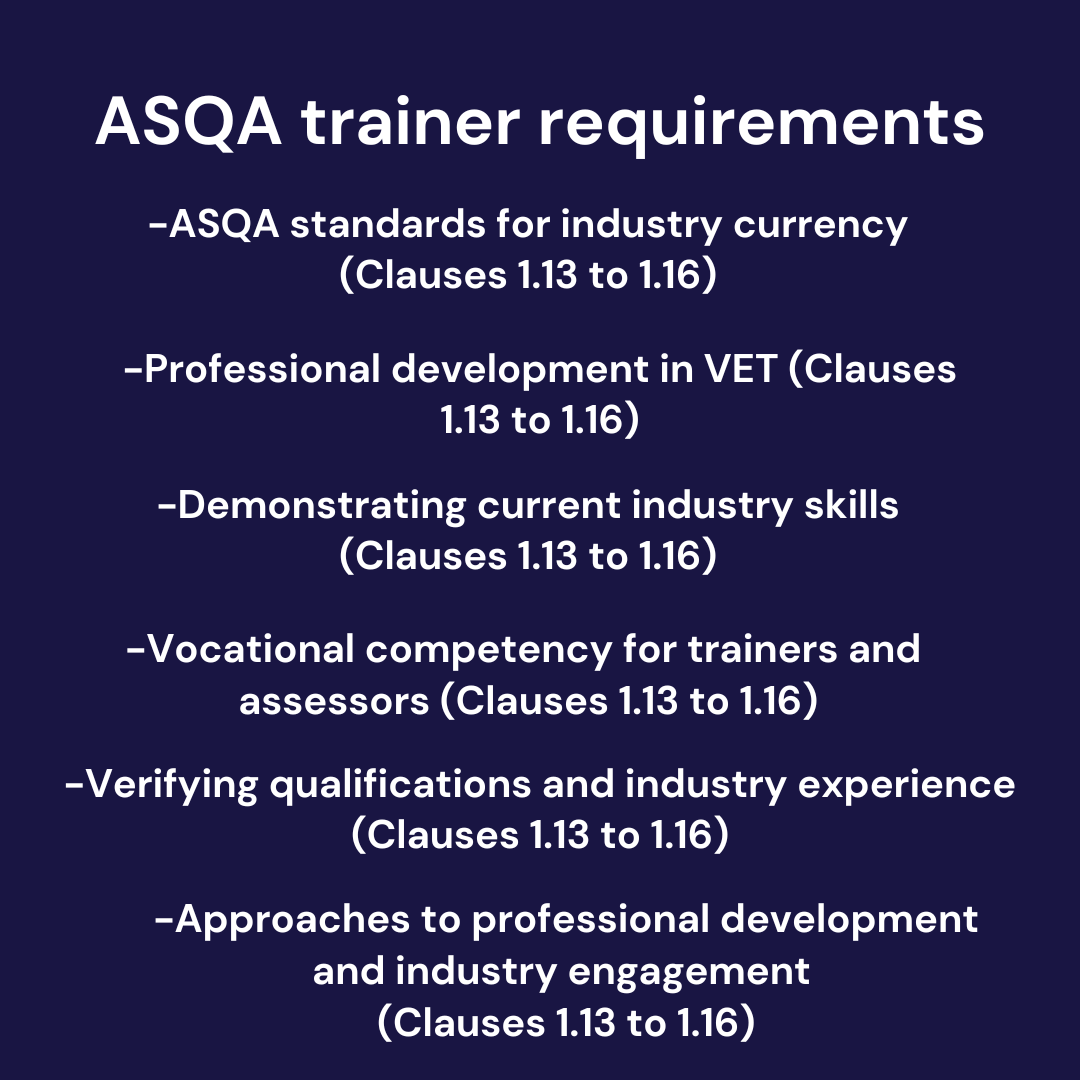
ASQA standards for industry currency (Clauses 1.13 to 1.16):
- Trainers and assessors must adhere to current industry skills and knowledge requirements.
- Vocational competency is essential in the relevant industry area and vocational education and training.
- Evidence must demonstrate alignment between trainer and assessor knowledge and the delivered training and assessment.
Professional development in VET (Clauses 1.13 to 1.16):
- Trainers and assessors must engage in ongoing professional development in vocational education and training.
- The frequency of professional development is unspecified but must ensure currency in vocational training and assessment.
- RTOs should retain evidence of completed professional development activities.
Demonstrating current industry skills (Clauses 1.13 to 1.16):
- Ideally, trainers and assessors should be regularly exposed to industry workplaces and participate in relevant tasks.
- Currency in skills varies based on the industry and can be shown through accredited training, industry associations, and staying informed about industry changes.
- Delivering training and assessment in a workplace does not guarantee current industry skills.
Vocational competency for trainers and assessors (Clauses 1.13 to 1.16):
- RTOs must retain evidence of relevant professional development in VET for all trainers and assessors.
- A specific form of evidence is not prescribed, but it may include maintaining registers of completed development activities.
- Vocational competency ensures effective training delivery and accurate student assessment.
Verifying qualifications and industry experience (Clauses 1.13 to 1.16):
- RTOs should verify trainers’ and assessors’ qualifications and industry experience through appropriate measures.
- Verification may involve viewing qualifications, confirming VET study through the Unique Student Identifier (USI) Registry, and conducting referee checks for industry experience.
- Records of verification should be maintained on individual human resources files.
Approaches to professional development and industry engagement (Clauses 1.13 to 1.16):
- RTOs can implement diverse approaches to professional development, including setting annual ASQA trainer and assessor requirements and maintaining activity registers.
- Engaging with industry representatives helps ensure trainers’ and assessors’ skills and knowledge remain relevant and current.
- Regular reviews and updates of required skills and knowledge should be conducted in collaboration with local industry representatives.
How RTOs Can Maintain Industry Currency?

- Participation in relevant professional development activities: Trainers and assessors can engage in continuous learning through workshops, seminars, and conferences that cover current industry trends and advancements. This diverse range of development activities ensures ongoing growth and adaptability.
- Completion of formal or non-formal training related to the industry: Undertaking accredited training or courses specific to the industry helps trainers acquire new skills and update their knowledge. This formal training may include certifications or short courses designed to enhance expertise.
- Active involvement in networks, communities of practice, or mentoring activities: Engaging in professional networks allows trainers to exchange knowledge, share best practices, and gain insights into emerging industry practices. Mentorship opportunities offer valuable guidance, promoting skill enhancement and knowledge exchange.
- Participation in industry release schemes or projects: Involvement in industry release schemes or collaborative projects allows trainers to work on real-world challenges, exposing them to current industry practices. Such projects foster innovation and inspire trainers to develop creative training
- Regular shadowing or collaboration with other trainers and assessors: Trainer’s benefit from observing and collaborating with colleagues who possess diverse expertise. This mutual exchange of ideas enhances their instructional techniques and reinforces industry alignment.
- Reading industry journals and publications: Staying informed through industry-related reading materials, journals, and publications keeps trainers updated on the latest research, technological advancements, and regulatory changes. This ensures they are well-versed in current industry knowledge.
- Volunteering or working part-time in the industry area: Hands-on experience in the industry, even on a voluntary or part-time basis, exposes trainers to practical challenges and real-life scenarios. This immersion aids in delivering contextual and relevant training and assessment.
- Belonging to industry associations: Membership in professional associations provides trainers access to industry-specific resources, networking opportunities, and updates on industry standards, further enriching their vocational competence.
- Engaging with industry stakeholders and employers: Active engagement with industry representatives and employers fosters an understanding of current workplace practices and emerging skill requirements. This dialogue aids trainers in aligning the training content with industry needs.
- Keeping up to date with changes to legislation and technology: Continuous monitoring of industry regulations and technological advancements ensures trainers deliver training that complies with legal requirements and integrates cutting-edge
Benefits of Maintaining Industry Currency

- Industry currency leads to improved training quality as trainers and assessors possess up-to-date skills and knowledge, enabling them to deliver relevant and effective training. This ensures students receive a well-rounded education, equipping them with practical skills needed for real-world scenarios.
- Maintaining industry currency ensures that trainers align their teaching with current industry practices, allowing students to learn skills directly applicable to their chosen fields. This relevance fosters a deeper understanding of industry requirements and enhances graduates’ employability.
- RTOs gain credibility with stakeholders, including employers and students, by having trainers with industry currency. Accredited qualifications backed by trainers with recent industry experience are more highly regarded, increasing the reputation of the RTO and its courses.
- Adhering to ASQA clauses 1.13 to 1.16 is crucial for RTOs to maintain their registration. Industry currency ensures that RTOs meet these standards, demonstrating their commitment to providing high-quality education and assessment.
- Trainers with industry currency can engage students with practical examples and real-life experiences, fostering an enriching learning environment. Students become empowered with relevant skills and knowledge, motivating them to succeed in their chosen careers.
- Industry currency enables trainers to stay updated with technological advancements, ensuring they integrate relevant tools and techniques into their training. Students benefit from exposure to innovative practices, preparing them for modern workplaces.
- Trainers with industry currency can anticipate industry trends, preparing students for long-term career success rather than focusing solely on immediate job market demands.
- Trainers with industry currency guide students on workplace practices, smoothing the transition from education to employment.
- Employers value RTO graduates with industry-current trainers, trusting their practical skills and knowledge. Employers are confident in the practical skills and knowledge of potential employees.
- RTOs benefit from industry currency as it encourages continuous improvement in training delivery and assessment methods, aligning with evolving industry needs.
- Trainers with industry currency ensure assessments are relevant and reliable, accurately evaluating students’ abilities and competencies.
- RTOs with trainers possessing industry currency can build stronger relationships with employers and industry stakeholders, leading to valuable collaboration and potential work-integrated learning opportunities for students.
Conclusion
Embracing industry currency not only benefits trainers and RTOs but also empowers students with the practical skills needed to thrive in their chosen careers and contribute to the ever-evolving industries. If you are an RTO trainer or assessor this blog answers questions like, “What practices support skill maintenance and development?”.
At VET Advisory Group, we offer RTO training resources as well as consulting to RTOs for creating the best learning experiences for your students. For more information contact us here.
Frequently Asked Questions
Q.1 What is Industry Currency?
A.1 Industry currency refers to the maintenance of up-to-date vocational technical skills and knowledge by trainers and assessors in a specific industry. It ensures that trainers stay current with the latest industry practices, allowing them to deliver relevant and effective vocational training to students.
Q.2. Why is Industry Currency Important?
A.2. Industry currency is crucial for several reasons:
It ensures the delivery of training that aligns with current industry practices and standards.
Students receive training that equips them with skills that are in demand by employers, increasing their employability.
Maintaining industry currency enhances the credibility and professionalism of trainers and assessors.
Compliance with industry currency standards is essential for Registered Training Organisations (RTOs) to maintain quality education.
Q.3. What is VET Currency?
A.3. VET currency, also known as Vocational Education and Training currency, refers to the current and relevant skills and knowledge of trainers and assessors in the VET sector. VET currency ensures that trainers possess the expertise needed to effectively deliver vocational education and training in line with industry requirements.