
An RTO plays a pivotal role in shaping a career to drive industry growth. It means your dedication as an RTO must be transformative. One way to ensure this transformation is by writing clear and concise learning outcomes.
You are not a stranger to learning outcomes yourself. Every unit of competency and qualification your trainers train has set learning outcomes. Clearly stated learning goals or outcomes make it easy for students to understand what’s expected of them and what they need to learn. This can help them feel more confident and satisfied with their progress.
But how to write clearly stated and apt learning outcomes?
We will discuss all about it in this blog. So, let’s begin.
In the blog you will learn:
- Where RTOs need to write learning outcomes?
- What are learning outcomes?
- A list of useful verbs to design learning outcomes
- Tips for Writing Learning Outcomes
- Examples of Learning Outcomes
- Checklist to self-evaluate your learning outcomes
Where RTOs need to write learning outcomes?
Beyond the set learning outcomes for units of competency and qualifications, you also need to set learning outcomes in several other instances:
- Pre-training: Training packages have their goals, but sometimes you need to add more. This could be because your students need extra help in certain areas or they’re all different.
- Work Placements: When students get on-the-job experience, you need specific goals for what they should learn. These goals should match the overall qualification but focus on using skills in the real world.
- Short Courses: For quick training programs, you need clear, measurable goals that students can achieve in a short time.
- Upskilling/Reskilling: If you’re helping workers learn new skills, you need to know what their gaps are and set goals accordingly. These goals could be about specific parts of a qualification or entirely new skills.
- Assessment: When you test students, the questions should match their learning goals. This makes sure the tests measure what they’ve learned.
- Special Needs: For students with extra needs, you might need to change the tests or their learning goals. But these changes still need to meet the overall qualification requirements.
- Program Improvement: As you review your training programs, you might need to change the learning goals. This could be because of industry changes, student feedback, or new rules.
- New Programs: When you start a new training program, you need clear learning goals to measure its success and get feedback for future improvements.
- Industry Partners: If you work with companies to develop training, you might set the learning goals together.
We have summarised it in the following table.
Table: Circumstances Where RTOs Set Learning Outcome
| When to Write Learning Outcomes | Why It’s Important |
| Pre-training Needs Analysis | To bridge existing knowledge gaps or cater to learner diversity |
| Work Placement and Workplace Learning | To focus on practical application and workplace skills |
| Short Courses and Skills Sets | To set clear, measurable, and achievable goals within a short timeframe |
| Upskilling and Reskilling Programs | To target specific knowledge and skills gaps for existing workers |
| Developing Assessment Instruments | To ensure assessments accurately measure student achievement |
| Reasonable Adjustments | To accommodate learners with disabilities or access needs |
| Monitoring and Evaluation | To ensure training remains relevant and effective |
| Pilot Programs and New Initiatives | To gather feedback and measure effectiveness |
| Industry Collaboration | To jointly develop training programs that meet industry needs |
What are learning outcomes?
Learning outcomes are clear descriptions of what a learner will be able to do, know, or understand after completing a training program or course. They tell us what the learner will have gained by the end.
A relevant and comprehensive definition of learning outcomes can also be found in the Australian Qualifications Framework (AQF):
“The learning outcomes are constructed as a taxonomy of what graduates are expected to know, understand and be able to do as a result of learning. They are expressed in terms of the dimensions of knowledge, skills and the application of knowledge and skills.”
(The AQF Second Edition January 2013, p. 11)
A list of useful verbs to design learning outcomes
Learning taxonomies are a classification able to organise the knowledge, skills, values or behaviours that teachers aim to teach. Taxonomies are like roadmaps for learning. They help us figure out:
- What: What knowledge and skills do we want students to gain?
- Why: Why are these things important for them to learn?
- How: How can we check if they’ve actually learned it?
These tools tell us what students should be able to do, not just memorise. This means focusing on what they gain from learning, instead of just what the trainer teaches.
The following example illustrates the application of this taxonomy and provides helpful verbs for developing learning outcomes.
| Type of Learning | Verbs To Be Used for Developing Learning Outcomes |
| Knowledge
(recalling facts) |
State, identify, select, define, name, match, quote, cite, report, deliver, write, relate, perform, identify, indicate, list, name, recall,
recognise, select, state, recount, illustrate |
| Comprehension
(Capacity to see and understand relationships) |
associate, convert, compare, outline,
translate, summarise, arrange, defend, discuss, describe, distinguish, estimate, explain, interpret, infer, demonstrate, outline, report, restate, review, suggest |
| Application
(use of knowledge) |
apply, determine, illustrate, restructure, solve, use, change, develop, employ, construct, demonstrate, discover, dramatise,
employ, illustrate, interpret, investigate, conduct, modify, operate, organise, classify, practice, predict, prepare, produce, schedule, sketch, solve, translate |
| Analysis
(Deconstruction and investigation of knowledge) |
analyse, examine, differentiate, examine, distinguish, categorise, question, summarise, research, categorise, differentiate, compare,
critique, relate, select, debate, determine, probe, structure, discriminate, experiment, distinguish, identify, question, solve, test |
| Synthesis
(Combining information into a new connected unit of knowledge) |
combine, assemble, compose, create, unify, formulate, design, integrate, propose, synthesise, adapt, rearrange, compile, construct, devise, explain, generate, plan, restructure, collate, systematise, propose, rearrange, reconstruct, systemise, relate,
reorganise, revise |
| Evaluation
(judging the value or appropriateness) |
evaluate, assess, critique, rate, score,
conclude, criticise, judge, defend, validate, prioritise, disprove, criticise, discriminate, estimate, contrast, revise, grade, justify, interpret, measure, calculate |
Tips for Writing Learning Outcomes
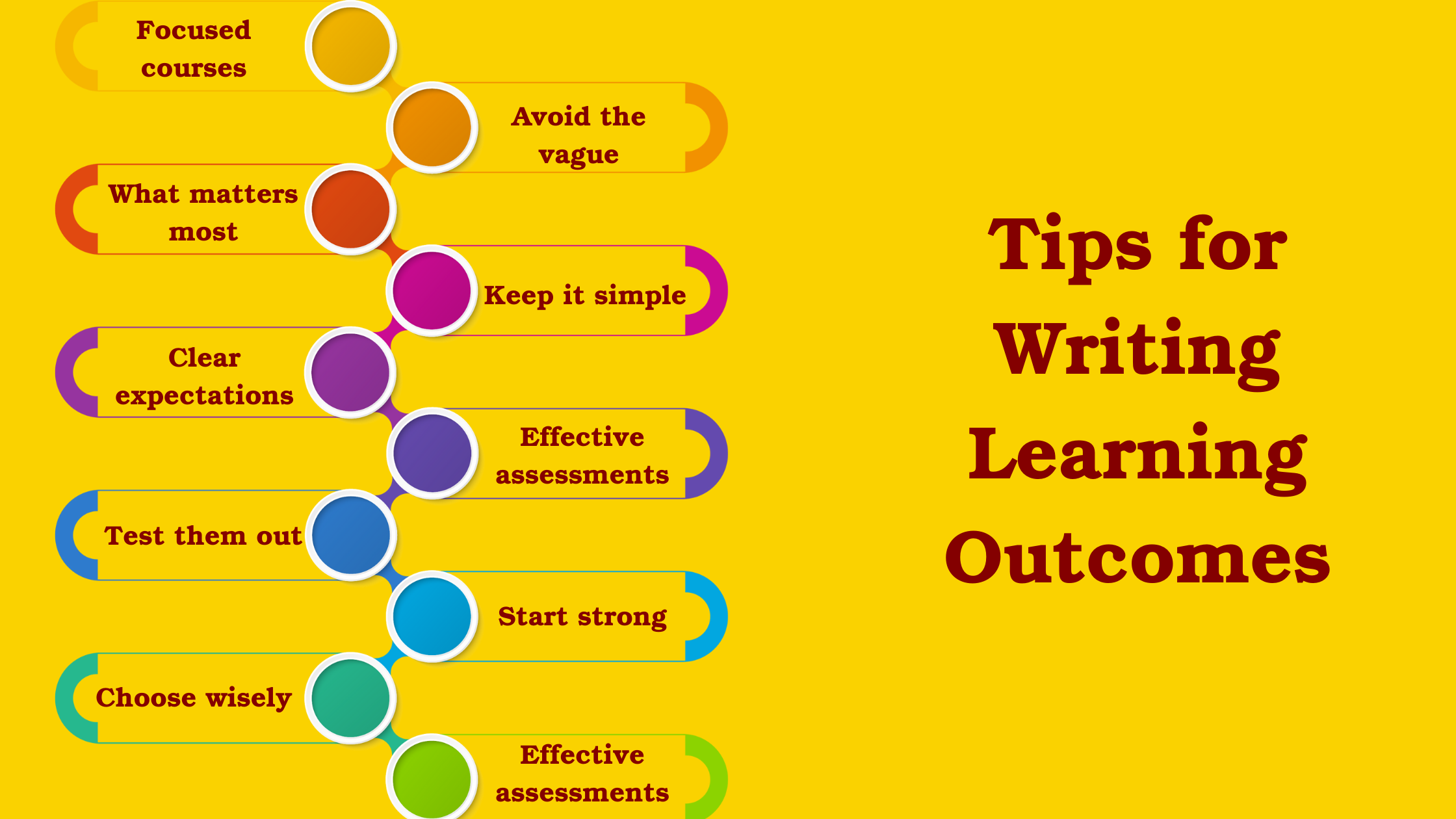
Creating clear and effective learning outcomes is crucial for your RTO students, and this guide will help you achieve that. Forget complex terms and fancy theories – we’ll break it down into simple steps you can follow to write outcomes that truly benefit your learners.
- Focused courses: By understanding what students should achieve, you can design your courses and assessments to directly target those goals.
- Clear expectations: When students know what’s expected from the outset, they feel confident and motivated to succeed.
- Effective assessments: Well-written learning outcomes help you craft precise assessments that accurately measure student progress.
- No one-size-fits-all approach: Every course and program are unique, so your learning outcomes will reflect that. Here’s what you need to keep in mind:
- What matters most: Think about the skills, knowledge, and abilities students should gain by the end. Focus on what they’ll be able to do, not just know.
- Start strong: Start each learning outcome with a clear statement like “Upon completing this course, students will be able to…”
- Choose wisely: Pick a verb that precisely describes the intended outcome. Use our handy verb lists, like Bloom’s taxonomy, to find the perfect match.
- Avoid the vague: Steer clear of verbs like “understand” or “learn” that open to too many interpretations. Stick to verbs that can be objectively measured.
- Keep it simple: Write clear, concise sentences that everyone can understand. Complicated jargon doesn’t belong here.
- Test them out: Ask colleagues or students to review your learning outcomes and ensure they’re clear, specific, and relevant to the course level.
Bonus Tip: Look for verbs specific to different learning levels (Refer the Table above) to create meaningful learning experiences for your students.
Based on these tips let’s look at few examples of learning outcomes that will give you a clear idea.
Examples of Learning Outcomes
Example 1: Level: Advanced Certificate
- Apply comprehensive knowledge of sustainable building principles and techniques to residential construction projects.
- Independently design and implement energy-efficient building systems into residential projects, demonstrating cost-effectiveness and environmental benefits.
- Effectively communicate the advantages of sustainable building practices to clients, colleagues, and the broader community.
- Source and implement sustainable building materials and products, adhering to relevant legislation and industry standards.
- Critically evaluate the environmental impact of different building materials and construction methods, making informed choices for sustainable projects.
Example 2: Level: Certificate III
- Apply a range of development theories to understand and respond to the diverse needs of children from birth to five years.
- Design and implement engaging learning experiences that promote cognitive, social, emotional, physical, and creative development.
- Effectively communicate and collaborate to create a supportive and inclusive learning environment.
- Recognise and respond to individual learning styles and abilities, adapting activities to meet their diverse needs.
- Develop strategies for managing challenging behaviours in a positive and respectful manner, promoting self-regulation and emotional development.
Checklist to self-evaluate your learning outcomes

- No fancy words here, just plain language students can understand.
- Every outcome should say exactly what students will be able to do after the course.
- Choose a verb that matches the level of the course and describes the expected level of learning.
- Does this knowledge or skill matter beyond the course?
- Can you see how these outcomes will shape your teaching and assessment methods?
- Can you design tasks that show if students have achieved the outcome?
- Does the outcome fit the level of study, faculty goals, and university values?
Conclusion
In the world of training and education, clearly defined learning outcomes are the cornerstone of effective instruction and student success. By carefully crafting and implementing these statements, RTOs and educators can achieve the following:
- Set clear expectations
- Guide focused teaching
- Enable meaningful assessment
- Ensure relevance and quality
- Empower learner-centered approaches
Whether you’re developing a new training program or refining an existing one, investing time and effort into crafting clear, measurable, and meaningful learning outcomes is an investment in both student success and the overall quality of education and training. By embracing the power of learning outcomes, RTOs and educators can create engaging, effective, and impactful learning experiences that prepare learners for success in their chosen fields.
Want Guidance and assistance in writing clear learning outcomes?
Then VET Advisory Group is your best option. We offer end-to-end guidance in all matters related to RTO operations. For free consultations and samples of training resources contact us here.
Frequently Asked Questions
What is the difference between aims, learning objectives and learning outcomes?
Aims: Big-picture goals of the course or program, like “equip students with critical thinking skills.”
Learning objectives: Specific targets for instruction, like “students will analyse arguments for logical fallacies.”
Learning outcomes: What students actually achieve, like “students can identify and explain various types of logical fallacies.” They show whether the objectives were met.