
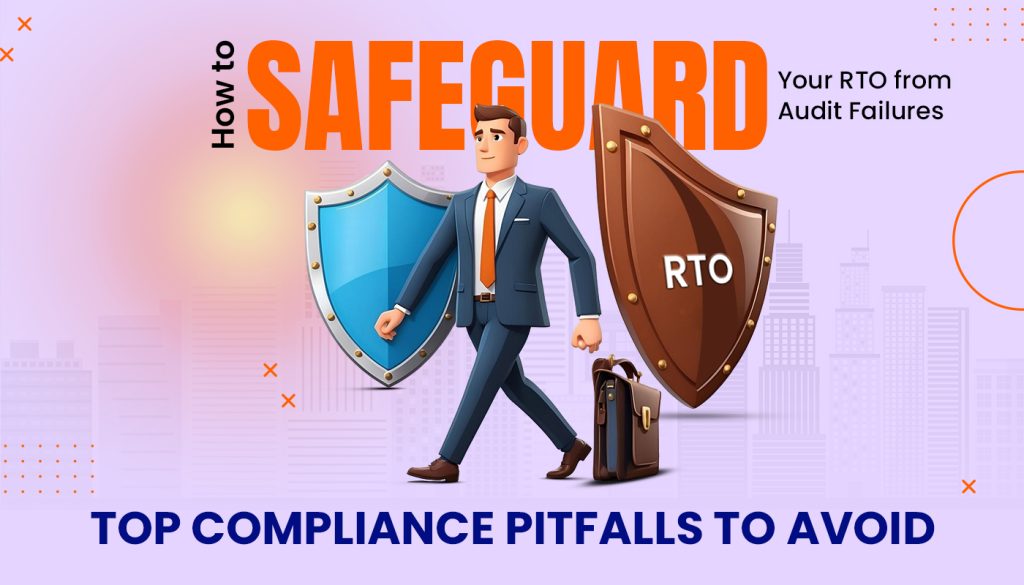
Practical audit risk management for RTOs: the most common compliance pitfalls that cause RTO audit failures—and how to prevent them with evidence that stands up.
ASQA’s regulatory lens is fixed firmly on quality of training and assessment and evidence of outcomes. For Registered Training Organisations (RTOs), this means audits are not about surprises—they’re about systems maturity. Audit failures rarely happen on the day; they’re the result of daily habits that either build defensible evidence or quietly erode it.
This mega guide unpacks the top compliance pitfalls that lead to RTO audit failures, the real non-compliance consequences, and a practical, step-by-step approach to preventing RTO audit failures. Whether you’re facing a performance assessment or proactively lifting your governance, use this as an operational playbook—complete with checklists, matrices, and implementation steps your team can action this week.
- Highlight: ASQA oversees 4,000+ RTOs delivering VET qualifications across Australia. The quality bar is high—your systems need to be higher.
- Inline CTA: Access RTO Assessment Resources – Audit-ready tools for compliant delivery and assessment.
Why RTOs Fail Audits

Auditors reveal what already exists in your systems—coherence, consistency, and credible evidence, or the lack of it. Three root causes dominate most audit failures:
- Assessment system weakness — tools don’t validly/fully assess unit requirements; assessor judgements are thin; insufficient workplace realism.
- Evidence gaps — policies say one thing, delivery does another; records don’t demonstrate that standards were met for each learner.
- Improvement inertia — findings from validation/internal audit/feedback aren’t resolved, verified, and institutionalised.
The antidote is a deliberate program of audit risk management for RTOs: define risks, install controls, measure effectiveness, and show your working with clean records.
The Top 12 Compliance Pitfalls
These go beyond merely “common mistakes.” Each pitfall includes signals (how to spot it early), risks (audit impact), and fixes (practical controls).
1) Assessment Tools Not Fully Mapped
- Signals: Missing/weak mapping to elements, performance criteria, knowledge evidence, foundation skills, and assessment conditions. Overlap or gaps across tasks.
- Risks: Invalid assessment decisions; non-compliance on unit coverage.
- Fixes:
- Build a task-to-requirement mapping matrix per unit.
- Use scenario-based tasks reflecting workplace context.
- Add assessor guides with clear criteria and sample evidence.


2) Over-Reliance on Knowledge-Only Assessment
- Signals: Heavy quizzes with minimal observation; scarce practical tasks or third-party verification.
- Risks: Competency awarded without demonstrated performance.
- Fixes:
- Balance with demonstrations, simulations, workplace artefacts, and assessor observations.
- Include conditions (tools, time, safety) that mirror real work.
3) Weak Assessor Judgements & Recording
- Signals: Blanket tick-boxes; no rationale/evidence references; identical comments across learners.
- Risks: Decisions are indefensible under scrutiny.
- Fixes:
- Introduce criterion-referenced rubrics and mandatory judgement notes.
- Moderate samples each term to calibrate standards.


4) TAS Misalignment with Delivery
- Signals: TAS lists cohorts/volumes/resources that don’t match what’s happening in classes or placements.
- Risks: Systemic non-compliance; misrepresentation.
- Fixes:
- Treat the TAS as a living operational plan.
- Update TAS whenever delivery model, resources, or assessment methods change; version-control.
5) Trainer/Assessor Competence & Currency Gaps
- Signals: Incomplete trainer matrices; vague PD records; outdated industry engagement.
- Risks: Findings against trainer suitability; compromised assessment quality.
- Fixes:
- Maintain a live trainer matrix linking each unit to vocational competence, TAE, PD, and currency.
- Require industry engagement hours and reflective statements on practice changes.


6) Tokenistic Industry Engagement
- Signals: Generic letters; no change to tools or TAS after “feedback”.
- Risks: Questioned industry relevance; facilities/resources misaligned with workplace.
- Fixes:
- Establish an Industry Reference Group per training area.
- Record feedback → decision → implementation → review, with timestamps.
7) LLND Not Informing Support & Assessment Adjustments
- Signals: Diagnostics conducted but not used; learners struggle; inconsistent adjustments.
- Risks: Unfair assessment; poor outcomes; complaints.
- Fixes:
- Create learner support plans linked to LLND results.
- Train staff on reasonable adjustments that don’t change competency requirements; record adjustments in tools and learner files.


8) RPL Inconsistency & Weak Evidence
- Signals: RPL outcomes vary widely; limited mapping; authenticity not demonstrated.
- Risks: Invalid RPL decisions; audit findings; appeals.
- Fixes:
- Standardise with RPL evidence guides, mapping templates, assessor interviews.
- Use authenticity checks (supervisor verification, artefact metadata) and currency rules.
9) Credit Transfer (CT) Verification Gaps
- Signals: CT granted without verifying AQF equivalence/issuing RTO.
- Risks: Non-compliant credit outcomes.
- Fixes:
- Validate unit codes/titles, issuing RTO details, transcripts.
- Keep a CT verification log with evidence.
10) Data Integrity & Reporting Errors (USI, AVETMISS)
- Signals: USI mismatches, late submissions, LMS–SMS discrepancies.
- Risks: Systemic confidence issues; sanctions.
- Fixes:
- Implement pre-submission data validation and reconciliation routines.
- Assign data stewards and a governance calendar.
11) Placement/Simulation Evidence Not Matching Conditions
- Signals: Missing supervisor logs; hours not evidenced; facilities/tools not aligned to unit requirements.
- Risks: Non-compliance on assessment conditions.
- Fixes:
- Document placement agreements, rosters, supervisor reports, hour logs.
- For simulation, maintain a facilities & equipment register mapped to units.


12) Continuous Improvement That Doesn’t Close the Loop
- Signals: Findings noted but no root-cause or effectiveness check; open items linger.
- Risks: Repeat findings; culture of compliance theatre.
- Fixes:
- Use a single Improvement Register with root cause, corrective actions, owner, due date, verification, and close date.
- Table it at Management Review
Audit Risk Management for RTOs: A Practical Framework
- Governance & Accountability – Create an Annual Compliance Calendar (validation, moderation, PD, industry engagement, data checks). – Assign process owners with KPIs tied to audit readiness.
- Risk Register & Control Library – Rate each risk (likelihood x impact) and define preventive controls (design) and detective controls (monitoring). – Example: Invalid assessment → Preventive: rigorous mapping; Detective: quarterly internal validation.
- Three Lines of Defence – Line 1: Trainers/assessors & coordinators (own delivery, assessment, evidence). – Line 2: Compliance (policies, training, monitoring, internal audits). – Line 3: Executive/Board (resources, independence, culture).
- Evidence Culture – If it isn’t documented, it didn’t happen. Build systems that nudge staff to create and file evidence during the work, not after.
- Management Review Rhythm – Quarterly Quality & Compliance Review: KPIs, learner outcomes, audit status, rectification progress, resourcing needs.
- Graphic suggestion: Flow chart: Risk Identification → Control Design → Monitoring → CAPA → Management Review.
Designing Evidence That Stands Up
- Assessment Mapping Matrix: Task-by-task coverage of elements/PC, KE, FS, assessment conditions.
- Observation Checklists: Past tense, behaviour-anchored, task-specific, with space for assessor notes and artefact references.
- Assessor Judgement Rationale: Brief, concrete notes—what was demonstrated, how verified, and references (photos, logs, interview notes).
- Trainer Currency Files: PD logs, industry engagement evidence, reflections on practice change; link to units taught.
- Industry Engagement Trail: Meeting notes, validation feedback, change logs, implementation dates.
- Data & Reporting Pack: USI proofs, AVETMISS validations, submission receipts, reconciliation worksheets.
- Improvement Register: Issue → Root cause → Action → Effectiveness verified → Closed.
Building a High-Quality Assessment System
- Start from the unit: Deconstruct performance requirements; build authentic tasks replicating real work.
- Balance methods: Knowledge, practical demonstration, product evidence, and third-party reports where appropriate.
- Write for reliability: Clear criteria; exemplar responses; “grey areas” clarified in assessor guidance.
- Fairness & flexibility: Adjust based on LLND/support plans without lowering the bar; document adjustments.
- Moderate & validate: Calendarised moderation to calibrate judgements; validation to test design validity.
- Version control: Date-stamp tools; track changes; archive superseded versions; communicate go-live dates to trainers.
Access Learning & Assessment Kit Samples – Professionally mapped and field-tested.
Trainer & Assessor Competency and Currency
- Maintain a trainer/assessor matrix linking each unit to:
- Vocational qualifications/experience (evidence of equivalence where required)
- TAE credentials and currency
- Industry engagement (hours, activities, outcomes)
- PD attended and impact on delivery/assessment practice
- Set expectations (e.g., 20+ hours/year industry engagement per trainer). Provide reflective templates: What did I learn? What did I change? Evidence?
- Run quarterly PD on assessment quality, evidence collection, data governance, and use of the TAS.

Industry Engagement That Actually Works
- Establish an Industry Reference Group for each training area with relevant employers/supervisors.
- Twice-yearly structured meetings covering role expectations, technology changes, facilities/tools, safety, and learner readiness.
- Log inputs → decisions → updates to TAS/tools/resources → implementation → post-implementation review.
- For placements: MOUs, supervision arrangements, hour logs, and feedback forms that directly feed into assessment improvements.
Implementation Roadmap: 90 Days to Audit-Ready
- Days 1–15: Baseline & Risk – Rapid internal audit on 3–5 high-enrolment units (tools, mapping, evidence packs). – Build/refresh the trainer matrix and Industry Engagement log. – Stand up the Improvement Register and assign owners.
- Days 16–45: Fix & Standardise – Rebuild mapping where gaps exist; add observation checklists and assessor rationales. – Standardise LLND support plans and RPL/CT packs. – Implement data governance routines and pre-submission checks.
- Days 46–75: Validate & Embed – Run moderation and validation; external peer review for at least one flagship unit. – Update TAS and publish a versioned change log.
- Days 76–90: Prove & Package – Compile audit packs per unit: mapping, tools, samples, assessor notes, logs, improvement actions. – Conduct a mock audit with executive/board oversight; close remaining gaps.
Data Integrity, Records & Reporting
- Build a data governance checklist covering USI verification, enrolment data hygiene, attendance/progress, results entry, outcomes, completions, AVETMISS.
- Run scheduled pre-submission validations; reconcile LMS (e.g., Moodle) and SMS (e.g., aXcelerate) data.
- Keep screenshots, receipts, and exception logs as part of your audit pack.
Continuous Improvement That Auditors Respect
- Operate one Improvement Register (not a scatter of spreadsheets).
- Source inputs from internal audits, validation, complaints/appeals, learner/employer feedback, outcomes data.
- Document root cause, corrective actions, responsible owner, due date, verification method, and close date.
- Present quarterly at Management Review; resource the stubborn issues.
LLND, RPL & Credit Transfer: Hot-Spot Controls
LLND – Use diagnostics to create learner support plans; align reasonable adjustments with unit demands; ensure instructions and tools reflect adjustments where applicable. – Keep a LLND-to-support linkage in the learner file with outcomes monitored.
Credit Transfer – Verify transcripts/records, unit codes/titles, issuing RTO; record evidence in a CT verification log.
RPL – Provide a standard RPL evidence kit with mapping and assessor interview prompts. – Triangulate evidence types; verify authenticity (supervisor statements, metadata); enforce currency windows.
FAQs
ASQA emphasises quality of training and assessment and demonstrable learner outcomes. Your registration, reputation, and commercial viability depend on meeting the Standards for RTOs and showing defensible evidence.
Weak assessment tools/mapping, inadequate assessor judgements, trainer currency gaps, tokenistic industry engagement, data/reporting errors, and a continuous improvement loop that doesn’t close.
Audit your top 5 units; fix mapping; strengthen observation checklists; verify trainer matrices; tighten USI/AVETMISS; create a unified Improvement Register; schedule validation/moderation.
Design from unit requirements; use workplace-realistic tasks; specify criteria and evidence expectations; moderate assessor decisions; lock in version control; keep a clean evidence trail.
Yes—request samples to evaluate mapping depth, clarity of guidance, and evidence prompts before adoption.
Rectification requirements, conditions on scope, suspensions or cancellations, reputational damage, lost revenue, and learner/industry trust erosion.
Stay ahead of ASQA compliance in the VET sector — request your free resource sample today.